
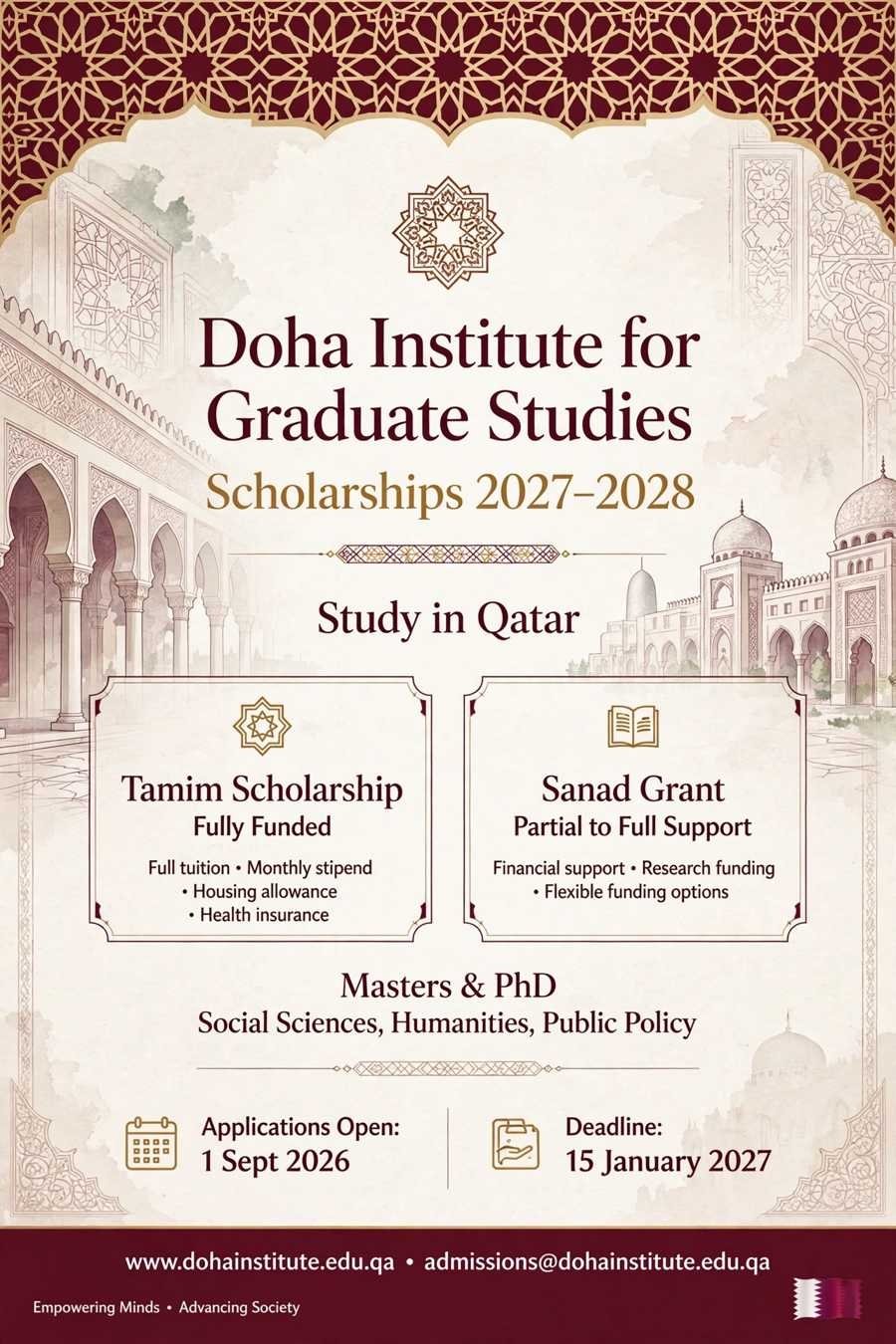
Country: Qatar
University: Doha Institute for Graduate Studies
Degree: Master's, PhD
Deadline: 2027-01-15
An Academic Environment Focused on Research and Critical Thinking The Doha Institute for Graduate Studies (DI) is an independent institution of higher education located in Doha, Qatar, with a strong focus on graduate-level education, research, and the development of knowledge. The institute aims to prepare individuals who can contribute to academic discussions, professional fields, public institutions, and the wider development of society. Its academic environment emphasizes analytical thinking, intellectual independence, research skills, and the ability to understand complex issues from different perspectives. Studying at a graduate institution involves much more than attending lectures and completing examinations. Students are expected to examine existing ideas, evaluate evidence, engage with academic literature, and develop their own reasoned conclusions. The learning environment at the Doha Institute is designed around these principles, encouraging students to approach questions critically and develop a deeper understanding of the subjects they study. The Role of Graduate Education in Professional Development Graduate education can provide an important bridge between undergraduate study and advanced professional or academic responsibilities. At the Doha Institute, the academic experience places importance on understanding concepts in depth, developing research-oriented thinking, and connecting theoretical knowledge with practical challenges. This approach can be valuable for students interested in careers that require sound judgment, effective communication, policy analysis, research, and informed decision-making. A graduate degree can also help students develop a more structured approach to solving problems. Instead of relying only on memorized information, students learn to identify questions, examine different explanations, assess available evidence, and present their conclusions clearly. These abilities are relevant across many professional environments, including education, research, public administration, social development, and other fields in which careful analysis is essential. An Institution with an International Academic Perspective Located in Qatar, the Doha Institute operates in a region that connects different cultures, economies, political systems, and intellectual traditions. This setting provides a valuable context for examining issues that influence the Middle East and the wider international community. Students can develop a broader understanding of regional and global affairs while learning to consider how historical, cultural, social, and economic factors influence contemporary developments. An international academic perspective is particularly useful in graduate education because many modern challenges cannot be understood through a single national or disciplinary viewpoint. Questions concerning development, governance, society, institutions, and international relations often involve multiple interconnected factors. Studying these questions encourages students to evaluate competing interpretations and recognize the importance of context when forming conclusions. The institute's academic setting can therefore be relevant to students who want to strengthen their understanding of regional issues while developing the ability to engage with wider international debates. This perspective can support intellectual growth and help students become more thoughtful participants in academic, professional, and public discussions. Research, Independent Learning, and Intellectual Development Research is an important part of advanced academic study. At the graduate level, students are generally expected to move beyond introductory knowledge and engage more deeply with the questions, debates, and methods associated with their areas of study. This process requires curiosity, discipline, careful reading, and the ability to distinguish between reliable evidence and unsupported assumptions. The academic environment at the Doha Institute for Graduate Studies places importance on developing these research-oriented abilities. Students may encounter different theoretical approaches, engage with scholarly arguments, and learn to organize information into coherent analyses. Such experiences can strengthen their ability to assess information critically and communicate complex ideas in a clear and structured manner. Independent learning is equally important. Graduate students must often manage substantial reading assignments, prepare academic papers, participate in discussions, and work toward longer-term research objectives. These responsibilities can help students develop time management, academic discipline, and intellectual confidence. Over time, these qualities can become useful in professional settings where individuals are expected to work independently while remaining accountable for the quality of their decisions and conclusions. Connecting Academic Knowledge with Real-World Challenges Higher education becomes especially valuable when students can connect academic concepts with the challenges faced by communities, organizations, and institutions. Issues affecting contemporary societies frequently require a combination of analytical ability, cultural awareness, communication, and an understanding of how institutions operate. The Doha Institute's broader academic mission is relevant to students who want to examine such issues through structured study and research. Graduate-level learning can help students understand why particular challenges emerge, how different stakeholders interpret them, and what kinds of evidence are needed to evaluate possible responses. This process encourages a more informed and balanced approach to complex questions. Students can also benefit from learning how to communicate their findings to different audiences. A well-developed argument must not only be logically sound but also presented in a way that others can understand and evaluate. Academic writing, presentations, discussion, and research-based assignments can all contribute to the development of these skills. An Academic Community That Encourages Discussion A productive graduate learning environment depends on meaningful engagement between students, faculty members, and academic ideas. Discussion allows students to encounter perspectives that may differ from their own, reconsider initial assumptions, and strengthen their arguments through evidence and reasoning. This type of intellectual exchange can be particularly valuable in an institution with an international outlook. Students may bring different educational experiences, professional interests, and interpretations of social or regional issues. Engaging respectfully with these differences can broaden understanding and encourage more thoughtful academic work. Graduate education also requires students to take responsibility for their own development. Faculty guidance and academic resources can support this process, but students must remain actively involved in their learning. Reading widely, asking relevant questions, seeking feedback, and improving written and spoken communication are important parts of making the most of a university experience. Understanding Scholarship Opportunities in a Graduate Institution Scholarship opportunities at universities can serve different purposes within the wider academic environment. Depending on the institution's policies, a scholarship may be designed to recognize academic achievement, support students with demonstrated financial need, encourage particular academic objectives, or advance the institution's broader educational mission. The precise purpose and conditions of any award should always be understood through the institution's official information. At the Doha Institute for Graduate Studies, scholarship arrangements should be considered within the context of its graduate education and institutional policies. Different awards may operate under different conditions, and students should not assume that every scholarship provides identical support or follows the same assessment process. The existence of a scholarship opportunity also does not automatically mean that every applicant will receive an award. For prospective graduate students, understanding this distinction is an important part of responsible academic planning. Scholarship information should be evaluated carefully, with attention to the official terms attached to the relevant opportunity. Students should also distinguish between admission to an academic programme and the separate decision concerning financial support whenever the institution treats these as distinct processes. Planning for Long-Term Academic and Professional Growth Choosing a graduate institution is an important decision that can influence a student's academic direction and professional development. Beyond the immediate experience of studying for a degree, students should consider the kind of intellectual environment in which they want to learn, the research questions that interest them, and the skills they hope to develop over time. The Doha Institute provides an academic setting in which graduate study, research, critical analysis, and engagement with regional and international issues are important considerations. For students seeking a deeper understanding of complex social and institutional questions, this environment may offer opportunities for intellectual development and more advanced academic work. A successful graduate experience ultimately depends on more than the institution itself. Students benefit most when they approach their studies with clear objectives, consistent effort, openness to different perspectives, and a willingness to improve through feedback. These habits can help them make meaningful use of their education and prepare for future responsibilities in academic, research-oriented, or professional environments. Prospective students should use the institute's official information as the authoritative reference for current institutional policies and scholarship arrangements. Careful research and realistic academic planning can help applicants make informed decisions about their graduate education and understand how a particular opportunity fits into their longer-term goals.
Explore master's and doctoral study opportunities at the Doha Institute for Graduate Studies in Qatar. Eligible Qatari and international applicants can be considered for merit-based Tamim Scholarships or need-based Sanad Scholarships. Funding may include tuition and other eligible expenses depending on the award. Review the current programme requirements, language criteria, scholarship conditions, and required documents before submitting your application.
Explore scholarships and opportunities by category