
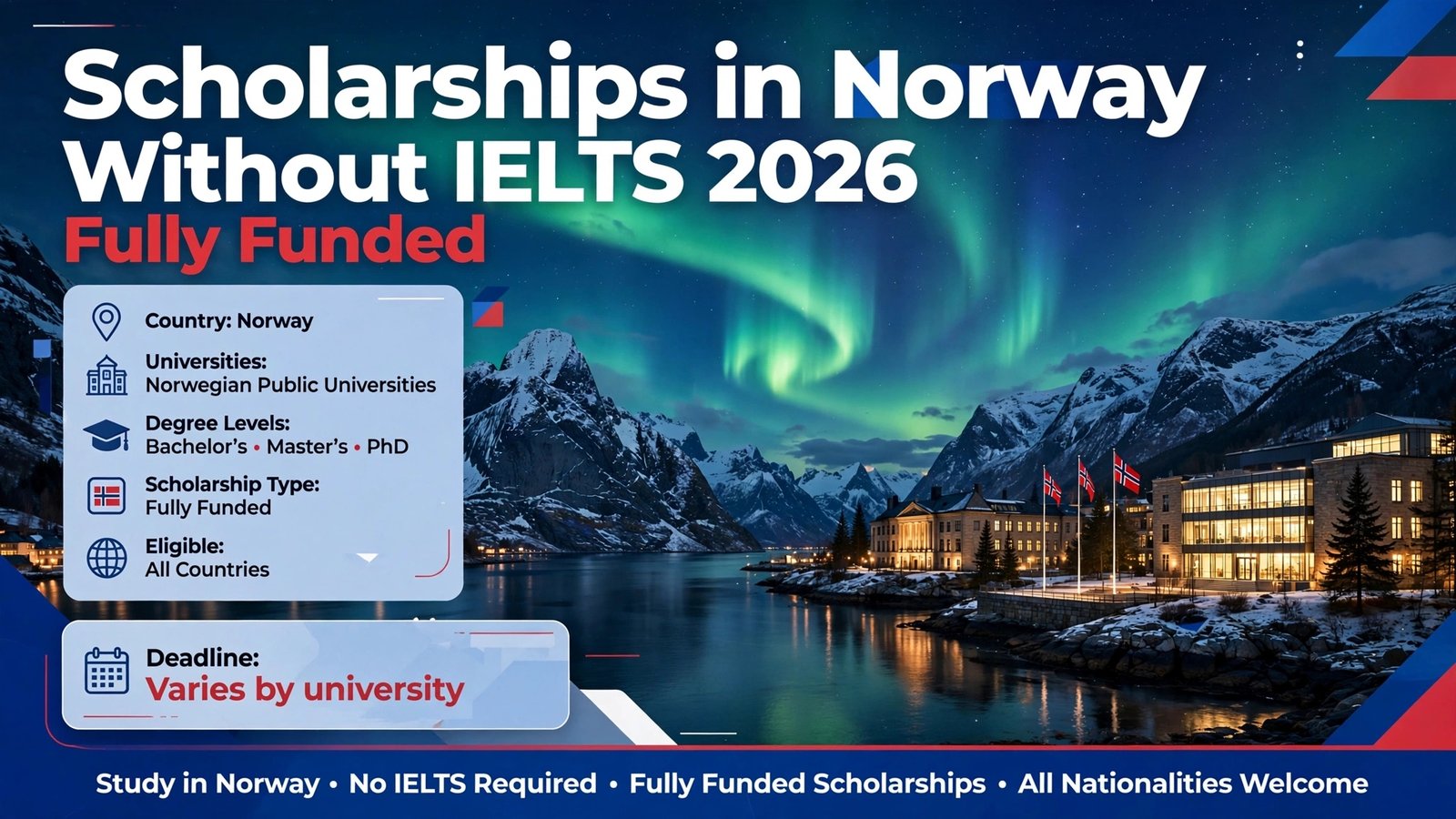
Country: Norway
University: Norwegian Universities
Degree: Bachelor's, Master's, PhD
Deadline: 2026-12-01
Norway is an attractive destination for international students seeking high-quality higher education, internationally recognised qualifications, and opportunities to experience life in Northern Europe. Students interested in studying in Norway in 2026 can explore undergraduate, postgraduate, doctoral, and joint-degree opportunities offered by Norwegian universities and other higher education institutions. Depending on the programme, students may also be eligible for scholarships, grants, research funding, or other forms of financial assistance. The Study in Norway scholarship opportunities discussed in this guide are not one single scholarship programme. Instead, they refer to different funding opportunities available through universities, international partnerships, foundations, and scholarship schemes. Applicants should understand this distinction because each funding opportunity has its own eligibility criteria, benefits, application process, and deadline. Norway offers a range of English-taught academic programmes. According to the official Study in Norway website, many English-taught programmes are available at master's level, while bachelor's and shorter programmes are also offered. PhD opportunities are frequently advertised as employment positions, with funding and conditions depending on the university, department, and research project. International students can explore study opportunities in fields such as engineering, computer science, business, economics, environmental studies, renewable energy, social sciences, health-related disciplines, and other academic areas. The availability of each subject depends on the institution and the specific degree programme. Students should check the official programme catalogue before deciding where to apply. One of the most frequently searched topics is studying in Norway without IELTS. However, this does not mean that every Norwegian university waives English-language requirements. Institutions generally require applicants to demonstrate sufficient English proficiency for programmes taught in English. Some universities or programmes may accept alternative evidence, such as an approved English-language test or documentation of previous education in English, when their rules allow it. Applicants must confirm whether their particular educational background qualifies for an exemption. Students should not assume that an English-medium certificate will automatically replace IELTS at every university. Accepted tests, minimum scores, exemption rules, and supporting documents can differ between institutions and programmes. The safest approach is to review the official language requirements for the intended degree and obtain confirmation from the admissions office if an exemption is unclear. The financial support available in Norway also varies considerably. Some scholarship schemes provide substantial support towards tuition and living expenses, while others cover only selected costs or provide funding for a specific period. Certain doctoral positions may offer a salary under an employment contract rather than a traditional student scholarship. Therefore, applicants should examine the actual funding terms instead of assuming that every opportunity covers tuition, accommodation, travel, health insurance, and monthly living expenses. The Norwegian government does not offer a general individual scholarship open to all international students pursuing degrees. Nevertheless, other funding schemes exist. One option worth investigating is the Erasmus Mundus Joint Masters programme, which involves international cooperation between higher education institutions and allows eligible students from around the world to apply for participating master's programmes. Scholarship availability, selection criteria, and application dates depend on the individual joint master's programme. University-specific scholarships and external funding opportunities may also be available to eligible students. Some are restricted by nationality, academic background, subject area, research interests, or previous participation in a particular programme. Others may be available only to exchange students or applicants applying through specific international partnerships. A scholarship that is open to international students is not necessarily open to every nationality or every degree level. For bachelor's applicants, it is particularly important to check the language of instruction and admission requirements. Some undergraduate programmes are taught in Norwegian and require Norwegian-language proficiency, while selected programmes may be offered in English. Admission procedures and recognition of previous education depend on the programme and institution. Students should also confirm that their secondary-school qualifications meet the applicable requirements. Master's applicants generally need a recognised bachelor's degree that meets the academic requirements of the intended programme. Universities may specify subject prerequisites, minimum grades, relevant coursework, and additional supporting documents. Applicants should carefully check whether their previous qualification is considered equivalent to the required Norwegian educational level. For doctoral applicants, universities and research institutions may publish PhD vacancies connected to specific research projects. These positions can have different funding arrangements, academic requirements, language expectations, and application deadlines. Applicants should read the vacancy announcement carefully and follow the institution's recruitment process rather than relying on a general scholarship application form. Students considering Norway should also plan for living expenses. The official Study in Norway website estimates student living costs at approximately NOK 15,488 per month, or NOK 170,368 per year, for 2026–2027. Actual expenses vary according to the city, accommodation, personal spending, and other circumstances. Tuition fees, where applicable, and other expenses may need to be budgeted separately. For applicants from outside the EU and EEA, a study permit may also be necessary. The Norwegian Directorate of Immigration provides the official requirements for study permits, including admission, financial documentation, and accommodation-related conditions. Students should verify the latest rules that apply to their nationality and intended programme before making financial or travel arrangements. The application deadline is not the same for every opportunity. Some university admissions periods and scholarship deadlines for 2026 may already have passed. Students planning to begin in a future intake should check the next application cycle and prepare documents well in advance. These may include academic transcripts, degree certificates, a passport, a CV, a statement of purpose, recommendation letters, and language evidence, depending on the programme. To begin, applicants should use the official Study in Norway website to explore institutions, degree programmes, admission requirements, and funding information. They should then visit the relevant university's official website to find the programme-specific application portal and scholarship instructions. If a scholarship requires a separate application, that application must also be completed according to its stated deadline. Scholarships in Norway without IELTS should therefore be understood as a search for programmes that may accept alternative English-language evidence, combined with funding opportunities for which the applicant is eligible. Neither an IELTS waiver nor full financial coverage is guaranteed across all Norwegian universities. Careful research and direct confirmation from the relevant institution are essential. For reliable information, applicants should consult the official Study in Norway website at https://studyinnorway.no/, its scholarship information at https://studyinnorway.no/scholarships-degree-students, and the relevant university's official admissions pages. These sources can help students identify legitimate programmes, compare funding conditions, verify language requirements, and determine the correct application deadline.
Discover study opportunities and scholarship schemes in Norway for international students. Explore bachelor's, master's and PhD programmes, check whether alternative English-language evidence is accepted instead of IELTS, and review available university funding and Erasmus Mundus opportunities. Scholarship coverage, eligibility and deadlines vary, so confirm all requirements through official university websites.
Explore scholarships and opportunities by category