
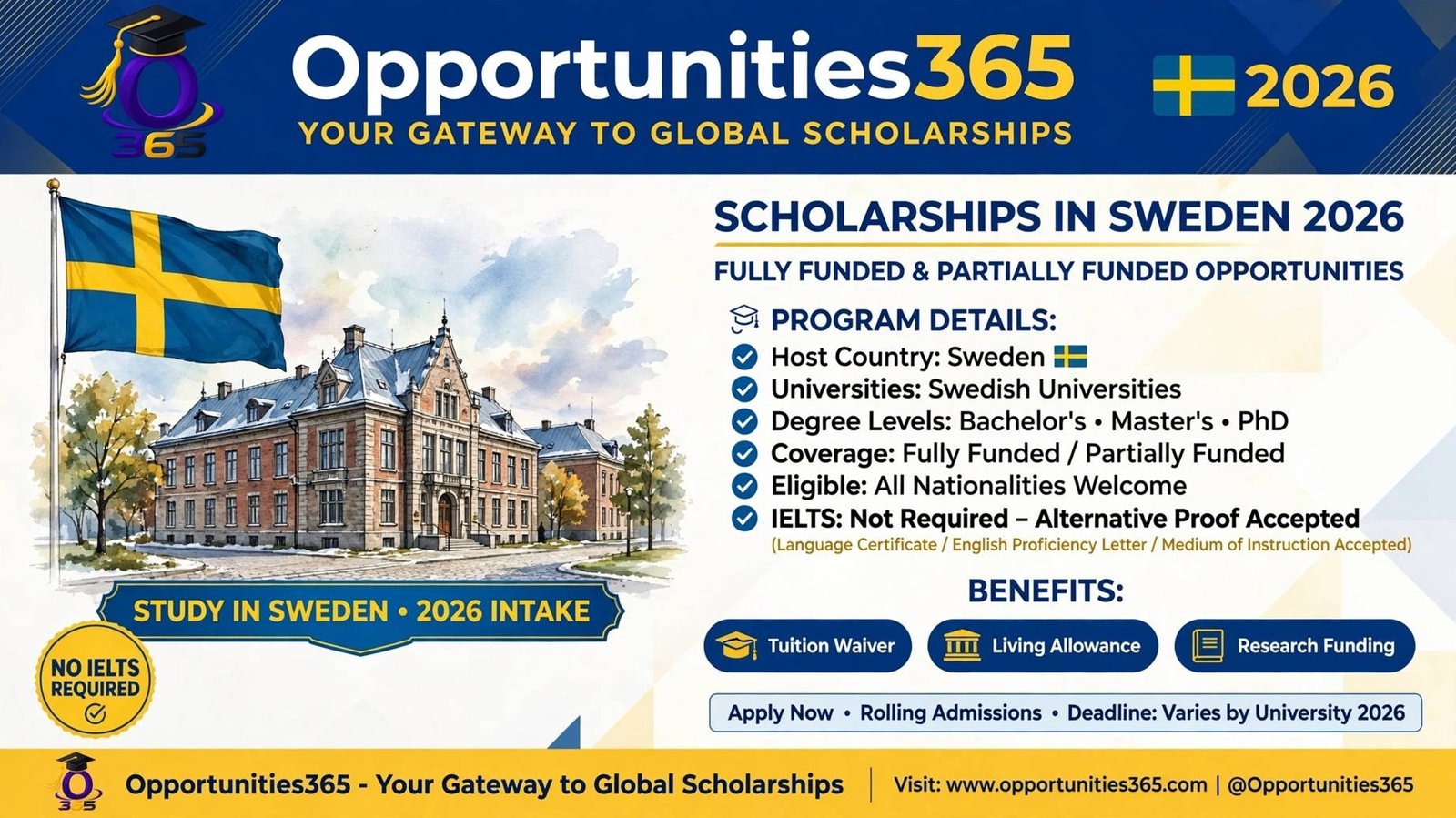
Country: Sweden
University: Multiple Swedish Universities
Degree: Bachelor's, Master's, PhD
Deadline: 2027-01-15
Study in Sweden Through International Scholarship Opportunities Sweden is a popular destination for international students seeking quality higher education, innovative research environments, and opportunities to develop internationally recognized academic qualifications. Swedish universities offer a wide range of programmes across science, engineering, business, economics, social sciences, humanities, technology, and other academic disciplines. International students can explore different funding opportunities to help manage the costs of studying in the country. Sweden Scholarships for International Students refers to a range of funding opportunities offered by the Swedish government, individual universities, foundations, and other organizations. These opportunities do not constitute one single scholarship programme. Instead, applicants can identify individual awards according to their nationality, academic qualifications, intended degree, field of study, and financial needs. Some scholarships provide full tuition fee coverage and a living allowance, while others cover only part of the tuition fee. Certain doctoral opportunities are advertised as paid university employment rather than conventional scholarships. Understanding these differences is essential when comparing funding opportunities in Sweden. About Higher Education in Sweden Sweden has an internationally oriented higher education system that encourages critical thinking, independent learning, research, and practical problem-solving. Many universities maintain international academic partnerships and provide programmes designed to prepare students for careers in research, business, public services, technology, and other professional fields. Students can choose from programmes taught in English as well as programmes taught in Swedish. English-taught programmes are particularly relevant to international applicants who do not speak Swedish, although students must still satisfy the language requirements specified by their chosen university. Swedish higher education often emphasizes analytical reasoning, collaboration, academic independence, and the practical application of knowledge. Students may participate in group projects, research assignments, laboratory activities, presentations, and discussions depending on their degree programme. This academic environment can be valuable for students who want to develop technical expertise, strengthen communication skills, or pursue advanced research. However, the structure, teaching methods, and admission criteria vary between institutions and programmes. Swedish Institute Scholarship Opportunities The Swedish Institute (SI) is a Swedish government agency that administers scholarship programmes for eligible international students. One of its established opportunities is the SI Scholarship for Global Professionals, which supports selected applicants pursuing eligible master's programmes in Sweden. This scholarship is competitive and intended for applicants who meet the programme's nationality, academic, professional experience, and leadership requirements. Applicants must also apply to eligible master's programmes and satisfy the relevant university admission requirements. For qualifying recipients, the scholarship can cover tuition fees and provide financial support towards living expenses. A travel grant may also be included under the applicable scholarship conditions. The exact coverage, eligible countries, participating programmes, and application procedures must be checked against the official call for the relevant academic year. The Swedish Institute Scholarship is not a general scholarship available to every international student or every degree level. Its eligibility rules and participating countries are specific to each scholarship programme. Applicants interested in undergraduate or doctoral study should investigate other funding opportunities because SI scholarships for global professionals primarily target master's-level education. The next application cycle should be checked through the Swedish Institute's official website. Prospective applicants planning to begin studies in autumn 2027 should monitor the forthcoming scholarship announcement and prepare their university applications in accordance with the published schedule. University Scholarships in Sweden In addition to government-funded awards, many Swedish universities offer scholarships to international students. These scholarships are usually administered directly by the institution and may be designed to attract academically strong applicants from outside the European Union and European Economic Area. University scholarships differ in their funding arrangements. Some awards provide a full tuition fee waiver, while others cover a specified percentage of tuition fees. Living expenses are not automatically included, even when a university describes an award as a scholarship. Applicants should identify their preferred universities and review the scholarship opportunities available through their official websites. They should also check whether the award requires a separate scholarship application or whether eligible students are considered automatically after applying for admission. Academic performance, programme selection, application timing, nationality, and other institution-specific conditions may influence eligibility and selection. Because scholarship budgets are often limited, meeting the minimum admission requirements does not guarantee that an applicant will receive financial assistance. Bachelor's, Master's, and Doctoral Study Opportunities International students can explore educational opportunities at different academic levels in Sweden, but the availability of scholarships differs by degree. Bachelor's programmes are available across a range of disciplines, although fully funded scholarships covering both tuition and living expenses are less common than applicants may expect. Students should investigate university-specific awards and confirm whether undergraduate applicants are eligible. Master's programmes offer a broad range of funding opportunities, including scholarships from the Swedish Institute and individual universities. Applicants should select programmes that match their previous academic qualifications and professional objectives. Doctoral education follows a different funding structure. In Sweden, many PhD positions are advertised as university employment, with a salary and employment conditions rather than a conventional student scholarship. Applicants should therefore search university vacancy pages and examine the terms of each doctoral position. Scholarships Without IELTS: Understanding the Requirements Many international students search for opportunities to study in Sweden without taking the IELTS examination. However, the phrase without IELTS does not mean that English language proficiency is unnecessary. Swedish universities require applicants to demonstrate that they meet the language requirements of their selected programmes. Depending on the programme and the applicant's educational background, accepted evidence may include certain previous studies, qualifications recognized under the official admission rules, or alternative approved English-language tests. The official University Admissions in Sweden website explains how applicants can meet the English requirement through recognized tests and qualifying previous education. Whether an applicant qualifies for an exemption depends on the specific rules and supporting documentation. For applicants educated in Pakistan or another country where English is commonly used in education, an English-medium instruction certificate alone should not be assumed to provide an exemption. Applicants should review the country-specific documentation requirements and the rules for their selected programme before deciding not to take an English-language test. Funding Coverage and Financial Planning Scholarship benefits vary significantly between programmes. Depending on the award, funding may include full tuition fee coverage, partial tuition reductions, monthly living support, travel assistance, or other specified benefits. A full tuition scholarship can reduce the cost of university education, but it does not necessarily pay for accommodation, food, transportation, insurance, or other personal expenses. Students should carefully review the funding terms before accepting an offer. International applicants should also consider the financial documentation required for a Swedish residence permit. The Swedish Migration Agency publishes the applicable maintenance requirements and explains how scholarship funding may be documented. Applicants should not assume that every scholarship is fully funded simply because it is advertised as an international scholarship. The official award conditions should clearly establish which expenses are covered and for what period. Preparing a Competitive Application A successful scholarship application begins with careful research. Applicants should identify programmes that match their academic background, check admission requirements, and review scholarship eligibility before preparing supporting documents. Commonly requested materials may include academic transcripts, degree certificates, a curriculum vitae, a motivation letter, recommendation letters, and evidence of language proficiency. Some programmes may also require a portfolio, research proposal, professional experience documentation, or additional programme-specific materials. Applicants should prepare accurate documents and follow the submission instructions provided by the relevant university or scholarship provider. They should also pay attention to application fees, document verification, and the separate deadlines that may apply to university admission and scholarship applications. For the autumn 2027 admission round, the official University Admissions calendar lists 16 October 2026 as the opening date and 15 January 2027 as the application deadline for the first international admission round. Scholarship deadlines may differ and should be checked separately. Conclusion Sweden Scholarships for International Students offer different routes for pursuing higher education in a European academic environment. Government scholarships, university awards, tuition fee waivers, and funded doctoral positions can help eligible applicants reduce education costs and pursue their academic goals. The best opportunity depends on the applicant's degree level, nationality, academic background, language qualifications, and financial needs. Students should verify the official eligibility criteria, funding coverage, programme availability, and deadlines before submitting an application. Applicants who want to study without IELTS should pay particular attention to the official language requirements. Alternative evidence may be accepted in qualifying circumstances, but an exemption is not guaranteed for every university or applicant.
Explore scholarship opportunities at Swedish universities for international students pursuing bachelor's, master's, and doctoral studies. Funding options include Swedish Institute scholarships, university tuition fee waivers, partially funded awards, and paid doctoral research positions. Some applicants may meet English language requirements without IELTS if they qualify under officially accepted alternatives. Funding coverage, eligible nationalities, degree levels, and deadlines vary by programme. Check official university and scholarship guidelines before applying.
Explore scholarships and opportunities by category