
Country: UK
University: Northumbria University
Degree: PhD
Deadline: 2027-01-11
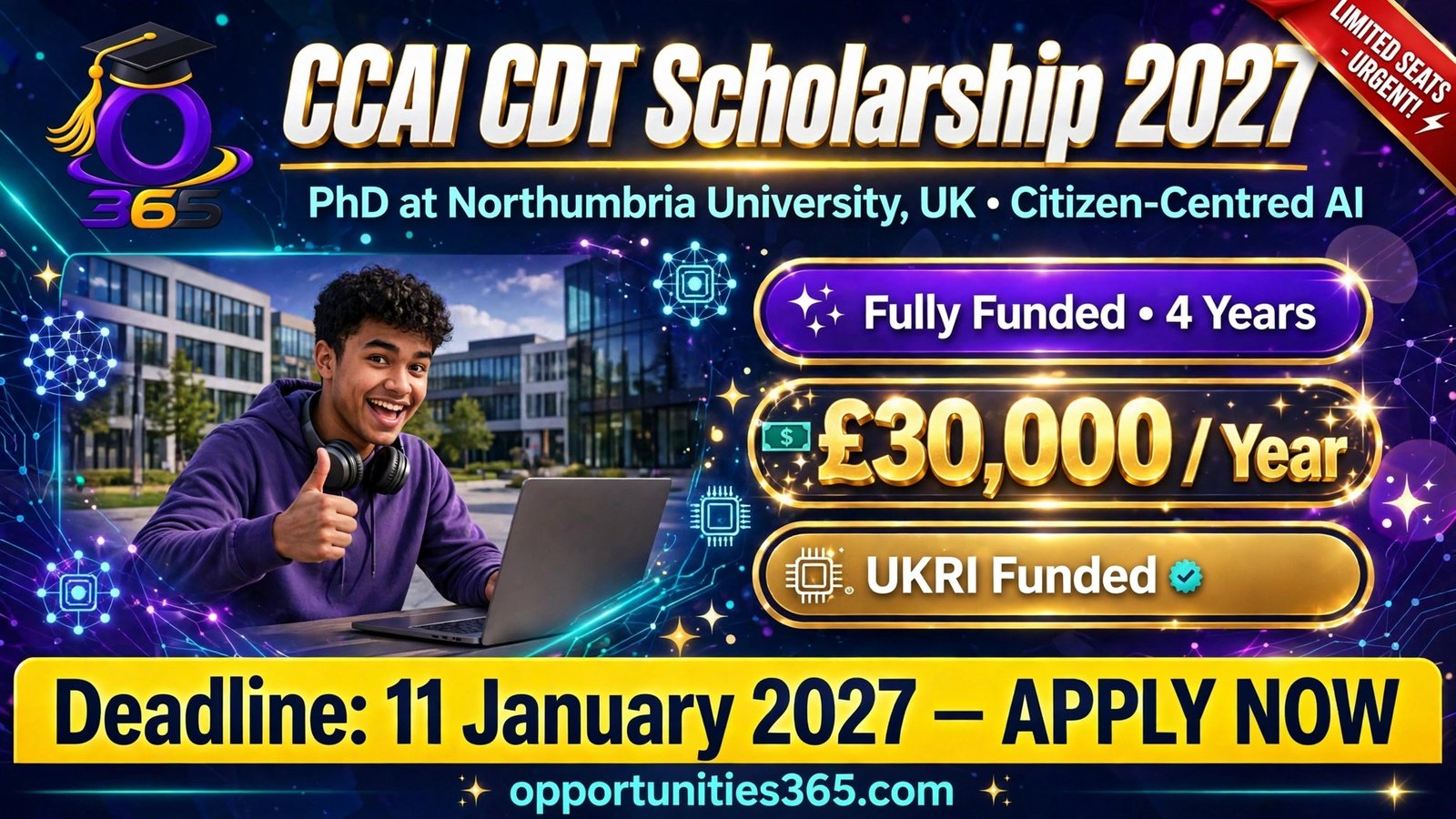
The CCAI CDT Scholarship 2027 is a fully funded doctoral research opportunity offered through the UKRI Centre for Doctoral Training in Citizen-Centred Artificial Intelligence at Northumbria University in Newcastle upon Tyne, United Kingdom. The programme aims to develop the next generation of researchers who can shape the future of artificial intelligence by placing citizens, communities and human needs at the centre of AI design, development and governance. Funded through UK Research and Innovation (UKRI), the programme provides successful candidates with a four-year PhD studentship covering tuition fees, a tax-free living stipend and research training support. Both UK and international applicants are welcome, although the number of available international studentships is limited. About the CCAI CDT Programme The Centre for Doctoral Training in Citizen-Centred Artificial Intelligence is an interdisciplinary research initiative hosted by Northumbria University. It brings together artificial intelligence, computer science, design, social sciences, law, humanities, business and public policy. The programme focuses on developing AI technologies that respond to the needs, values and interests of individuals and communities. Rather than concentrating exclusively on technical innovation, the research approach explores how citizens can participate in decisions about the development, deployment and governance of artificial intelligence. Doctoral researchers become part of an interdisciplinary academic community where they collaborate with researchers, professionals, public organisations and industry partners. An important feature of the programme is that applicants do not need to have a previous degree specifically in artificial intelligence or computer science. Candidates from different academic and professional backgrounds are encouraged to apply if they have a research interest related to citizen-centred AI. 2027 PhD Admission Cycle Northumbria University is recruiting its fourth cohort of doctoral researchers for September 2027 entry. Applications opened on 12 October 2026 and will close on 11 January 2027 at 17:00 GMT. The programme also provides an opportunity for prospective candidates to request feedback on their research proposals before submitting their final applications. The deadline for requesting this feedback is 11 December 2026. Shortlisting is scheduled to begin on 12 January 2027, followed by interviews on 15 February 2027. Successful applicants are expected to receive offers from 22 February 2027. The new doctoral cohort is scheduled to begin on 21 September 2027. Scholarship Benefits and Financial Support Successful candidates receive a fully funded four-year UKRI doctoral studentship. The funding package includes full tuition fee coverage, an annual tax-free living stipend and a research training grant to support doctoral research activities. For international students, the published UKRI stipend rate for 2026/27 is £21,805 per year. The programme also covers full international tuition fees, meaning international scholars do not have to pay the difference between UK and international tuition rates. For eligible full-time students with UK home-fee status, the government-funded TechFirst initiative provides an enhanced annual stipend of £30,000 for September 2027 entry. The standard UKRI stipend is expected to increase annually. Part-time studentships receive funding on a pro-rata basis. International applicants should note that student visa application fees, the Immigration Health Surcharge, English language test costs and travel to the UK are not included in the studentship funding. Research Areas and Strategic Challenges The CCAI CDT programme invites applicants to develop original research proposals connected to its six strategic research challenges. Growing Up with AI explores how artificial intelligence influences childhood, education, young people's development and their experiences of digital technologies. Health and Care examines how AI can support healthcare, wellbeing, care services and the relationships between technology and human needs. More-than-Human AI investigates relationships between artificial intelligence, the natural environment and the wider world beyond human-centred applications. Resilient Societies explores how AI can help communities and institutions respond to disruption, uncertainty and changing social conditions. Safer Digital Futures focuses on the development of trustworthy, responsible and safer digital environments through citizen-centred approaches. The Future of Work examines how artificial intelligence is transforming employment, workplaces, professional activities and relationships between workers and technology. Applicants are encouraged to identify a research direction that connects their interests with one or more of these strategic challenges. Interdisciplinary Research and Academic Training The programme offers doctoral training across several academic disciplines, including artificial intelligence and data science, human-computer interaction, participatory design, psychology, business, law, regulation and governance theory. Students receive opportunities to work with researchers from different academic backgrounds and develop the technical, analytical and professional skills required for interdisciplinary research. The programme also encourages collaboration with industry, government and community organisations. Doctoral researchers may participate in placements, conferences, summer schools, public engagement activities and visits to research laboratories. This structure allows students to develop their research capabilities while understanding how AI systems affect people and society in practical environments. Who Can Apply? The programme welcomes applications from UK and international candidates, including applicants from Pakistan and other countries. Applicants may come from computer science, artificial intelligence, engineering, psychology, social sciences, law, business, design, humanities or other relevant disciplines. Candidates normally need a Bachelor's degree with at least a UK 2:1 classification or equivalent qualification. A Master's degree, preferably with Merit or above, is also expected. Applicants may alternatively provide evidence of substantial professional or practitioner achievement through Accreditation of Prior Experiential Learning (APEL), where accepted. Previous specialist AI research experience is not compulsory. However, candidates must demonstrate a clear research interest and the ability to undertake doctoral-level study. Applicants who already hold a PhD or are currently undertaking doctoral study are not eligible. Research Proposal Requirements A research proposal is one of the most important components of the application. Candidates must use the official CCAI research proposal template and follow the word limits specified in each section. The proposal should explain the research challenge, its significance, relevant academic literature, proposed research methodology, ethical considerations and equality, diversity and inclusion implications. Applicants must also explain how their proposed research aligns with the citizen-centred AI vision and the programme's strategic research challenges. Research proposals submitted without the required template or with incomplete sections may be automatically rejected. Selection and Interview Process Applications are reviewed by an academic selection panel. Shortlisted candidates are invited to participate in an online interview. The interview process includes discussion of academic research papers and an opportunity for applicants to explain their proposed research and respond to feedback. The selection process aims to identify candidates with strong academic potential, research motivation and the ability to contribute to the interdisciplinary CCAI research community. Why Consider This PhD Scholarship? The CCAI CDT Scholarship provides an opportunity to undertake advanced doctoral research in one of the most important emerging areas of artificial intelligence. Students gain access to interdisciplinary research training, academic supervision, professional networking and opportunities to collaborate with industry, government and community organisations. For graduates interested in AI engineering, responsible AI, human-computer interaction, AI governance, digital society and research, the programme offers a pathway to develop advanced research expertise. International candidates interested in pursuing a fully funded PhD in the United Kingdom should explore the available strategic challenges, prepare an original research proposal and submit their applications before 11 January 2027.
Explore scholarships and opportunities by category