
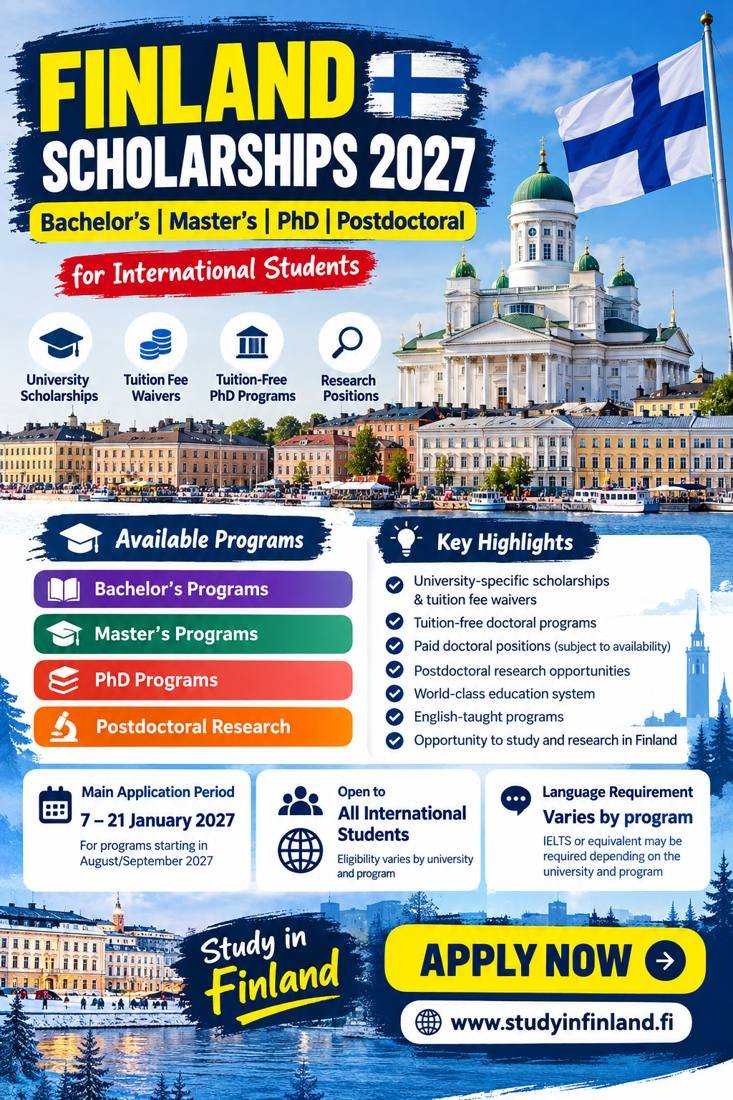
Country: Finland
University: Different Finnish Universities
Degree: Bachelor’s, Master’s, PhD, Postdoctoral Research
Deadline: 2027-01-21
Introduction Finland offers a range of higher education opportunities for international students through its universities and universities of applied sciences. International applicants can find Bachelor’s and Master’s degree programmes taught in English, while doctoral education and research opportunities are also available through Finnish universities. However, applicants should understand an important distinction regarding the widely advertised “Finland Fully Funded Scholarship” claims circulating online. The official Study in Finland platform, maintained by Finnish higher education authorities, states that there are no Finnish government scholarship programmes for Bachelor’s or Master’s studies. Instead, individual Finnish universities may offer their own scholarships, tuition fee waivers, or other forms of financial support. These university scholarships are competitive and generally do not cover students’ living expenses. 2 Therefore, this opportunity should be understood as a collection of Finnish university scholarships and funding opportunities, rather than one nationwide government-funded scholarship that automatically provides tuition, accommodation, airfare, health insurance, and monthly stipends to every successful applicant. Study Opportunities in Finland Finland is home to universities and universities of applied sciences offering programmes across numerous academic disciplines. International students from outside the European Union, European Economic Area, and Switzerland can apply to eligible English-taught Bachelor’s and Master’s programmes. For non-EU/EEA/Swiss students, English-taught Bachelor’s and Master’s programmes generally carry tuition fees. According to the official Study in Finland platform, tuition fees typically range from approximately €9,000 to €20,000 per academic year, depending on the university and programme. 3 Finnish universities may provide scholarships or tuition fee waivers to eligible international students. The exact amount and conditions differ between universities and programmes. Applicants should therefore identify their preferred degree programme first and then check the scholarship information provided by the university offering that programme. Bachelor’s Scholarships International students can find scholarship opportunities at Bachelor’s level through individual Finnish universities. Scholarships may take the form of partial or full tuition fee waivers, depending on the institution and programme. Some universities allow applicants to apply for a scholarship at the same time as their degree programme application. The official Study in Finland platform recommends that applicants search for their desired programme through Studyinfo.fi or directly through Finnish university websites. Once a programme has been identified, applicants should check its scholarship and tuition information. 4 Bachelor’s scholarship conditions can include academic merit, admission to a specific programme, nationality or tuition-fee status, and other programme-specific criteria. Applicants should not assume that a scholarship covers accommodation, food, travel, insurance, or other living expenses unless the individual university explicitly states this. Master’s Scholarships Finland has a large selection of English-taught Master’s programmes. Individual universities can offer scholarships to international students who are liable to pay tuition fees. Depending on the university, these scholarships can cover part or all of the tuition fee. For example, the University of Helsinki offers scholarships for eligible international students applying to its English-language Master's programmes. Its scholarship programme includes tuition fee waivers, with the exact scholarship conditions determined by the university. 5 Similarly, Aalto University offers a limited number of scholarships in the form of tuition fee waivers for fee-paying international students in English-taught Bachelor’s and Master’s programmes. Aalto states that these scholarships are highly competitive. 6 These examples demonstrate that Finland does have significant scholarship opportunities, but they are administered by individual universities rather than through one nationwide Finnish government scholarship programme. PhD Opportunities Doctoral education in Finland is different from Bachelor’s and Master’s education. According to the official Study in Finland platform, doctoral programmes do not charge tuition fees regardless of nationality. However, doctoral students are responsible for financing their living expenses. 7 Funding may be available through paid doctoral positions, research funding, university funding, scholarships, research projects, and other sources. Applicants interested in a PhD should therefore contact the relevant university department, identify suitable research areas and supervisors, and investigate available funding opportunities. Finnish universities may advertise paid doctoral positions separately from ordinary degree admissions. Postdoctoral Research Opportunities Finland also offers opportunities for researchers at the postdoctoral level. Postdoctoral positions are generally advertised by universities, research institutes, and academic recruitment platforms rather than through one national scholarship application. The official Study in Finland platform directs researchers toward university announcements and academic recruitment resources such as Euraxess and other research-related platforms. 8 Postdoctoral applicants should therefore search for specific research positions matching their academic background and research expertise. No Finnish Government Scholarship for Bachelor’s and Master’s One of the most important facts for applicants is that Finland does not currently operate a government scholarship programme covering all tuition and living expenses for international Bachelor’s and Master’s students. The official Study in Finland website explicitly warns applicants about social-media posts and advertisements claiming to offer “fully funded Finland government scholarships.” It states that these claims are misleading. 9 This means applicants should be careful when they see claims such as: “Finland Government Fully Funded Scholarship 2026” “Finland Government Scholarship Without IELTS” “Finland Scholarship with Free Air Ticket and Accommodation” Such claims should not automatically be treated as official Finnish government programmes. Instead, applicants should verify the scholarship directly through the university offering the degree programme or through official Finnish higher education platforms. Tuition Fee Waivers For international Bachelor’s and Master’s applicants, the most common university scholarship mechanism is a tuition fee waiver. A tuition waiver can cover part or all of the tuition fee, depending on the university. For example, Aalto University states that its scholarships are provided as tuition fee waivers and that a limited number are available to fee-paying international students. 10 The University of Helsinki similarly provides scholarships covering 50% or 100% of tuition fees for eligible Master's students. 11 However, a tuition waiver does not automatically mean that accommodation, food, transportation, health insurance, airfare, residence-permit expenses, or other living costs are covered. Applicants must therefore create a separate financial plan for living expenses. Living Costs The official Study in Finland platform currently estimates that international students should plan for approximately €900–€1,200 per month in living expenses. These expenses can include accommodation, food, transportation, study materials, personal expenses, and other everyday costs. The official guidance recommends that students prepare to cover their living costs independently. 12 This is particularly important for students who receive only a tuition fee waiver. Even when tuition is fully waived, students may still need substantial funds for their everyday life in Finland. Application Fee Applicants from outside the EU/EEA and Switzerland should also be aware that Finland introduced a €100 national application fee for degree applications to higher education programmes from 1 January 2025, with specified exemptions. The fee generally applies to applications leading to a higher education degree, while doctoral degree applications and Erasmus Mundus programmes are excluded from this application fee. 13 Therefore, the claim that Finnish university applications are universally “No Application Fee” is not accurate for non-EU/EEA applicants. January 2027 Joint Application For international students planning to begin Bachelor’s or Master’s studies in Finland in August or September 2027, the main national joint application period is scheduled for 7–21 January 2027. The official Study in Finland platform states that this joint application will cover English-taught Bachelor’s and Master’s programmes. Applicants can apply to multiple programmes through the joint application system, subject to the applicable rules. 14 Not every Finnish programme necessarily participates in the joint application. Some programmes have their own separate application periods. Applicants should therefore check Studyinfo.fi and the individual university's admission page. How to Find a Scholarship The recommended approach is to begin with the degree programme rather than searching for a generic “Finland fully funded scholarship.” First, select the academic field and degree level. Next, search for suitable programmes on Studyinfo.fi or on official university websites. After selecting a programme, check its tuition fee information. Then review the scholarship or tuition-waiver options available to international students. Applicants should carefully read the scholarship conditions, including the percentage of tuition covered, renewal conditions, academic requirements, and whether any separate application is required. University of Helsinki Example The University of Helsinki provides an example of how Finnish university scholarships work. Eligible international applicants to Master's programmes can apply for tuition fee scholarships. The university currently provides scholarships that can cover 50% or 100% of tuition fees. 15 However, the scholarship does not automatically provide a monthly living stipend, free accommodation, or international airfare. This is representative of why applicants must examine the exact terms of each university scholarship. Aalto University Example Aalto University also offers scholarships for international students liable for tuition fees. The university describes these scholarships as tuition fee waivers and states that they are limited and highly competitive. 16 Again, applicants should distinguish between a tuition fee waiver and a fully funded living package. English Language Requirements There is no single Finland-wide IELTS rule for all universities and programmes. English language requirements are established by the individual university and degree programme. Some programmes may accept IELTS, TOEFL, PTE, Cambridge qualifications, or other approved evidence, while exemptions may be available in specific circumstances. Therefore, the statement “Finland without IELTS” should not be interpreted as meaning that IELTS is universally unnecessary. Instead, applicants should check the language requirements of their chosen programme. If IELTS is not required because the programme accepts another qualification or the applicant qualifies for an exemption, that condition should be verified directly with the university. Doctoral and Research Funding For PhD applicants, the funding situation is different from Bachelor’s and Master’s education. Because Finnish doctoral programmes do not charge tuition fees, the main financial challenge is living expenses. Funding may come through paid doctoral researcher positions, university research projects, research grants, scholarships, or other research funding. The official Study in Finland doctoral funding guidance recommends contacting university departments and investigating paid doctoral positions and research funding opportunities. 17 The previously available EDUFI Fellowship programme for doctoral students and researchers was discontinued in October 2025, so applicants should not apply using outdated EDUFI Fellowship information. 18 Postdoctoral Researchers Postdoctoral researchers should search for specific vacancies and funded research projects. The official Finnish higher education guidance points researchers toward university websites, Euraxess, and other academic recruitment platforms. Postdoctoral funding is therefore normally connected to a specific research position, project, fellowship, or institution rather than one general “Finland scholarship” application. Who Can Apply? Eligibility depends entirely on the programme and scholarship. Bachelor’s applicants need to satisfy the admission requirements of the selected Bachelor's programme. Master’s applicants need a suitable previous degree and must satisfy the academic and language requirements of the selected programme. PhD applicants normally require a relevant Master's-level qualification and must meet the doctoral programme's research and academic requirements. Postdoctoral applicants must normally have completed a relevant doctoral degree and satisfy the requirements of the advertised research position. International applicants should always check the individual programme's eligibility rules. Important Funding Warning Applicants should be particularly cautious about advertisements claiming that one Finnish government scholarship provides: Full tuition Monthly stipend Free accommodation Return airfare Health insurance No application fee for all international Bachelor’s, Master’s, PhD, and postdoctoral applicants. The official Study in Finland website specifically warns that such broad claims about Finnish government scholarships are misleading. 19 Different types of funding exist in Finland, but they come from different sources and have different eligibility requirements. Final Overview Finland offers excellent opportunities for international students and researchers through its universities, doctoral programmes, research projects, and university-specific scholarships. For Bachelor’s and Master’s students, scholarships are primarily offered by individual universities and commonly take the form of partial or full tuition fee waivers. They are competitive and generally do not cover living expenses. 20 For PhD students, Finnish doctoral programmes are tuition-free regardless of nationality, but students need to arrange funding for their living expenses. Paid doctoral positions and research funding can provide financial support. 21 For postdoctoral researchers, opportunities are generally advertised as specific research positions, fellowships, or funded projects. The main joint application for English-taught Bachelor's and Master's programmes beginning in August/September 2027 is scheduled for 7–21 January 2027. 22 Applicants should use official Finnish sources, Studyinfo.fi, and individual university websites to verify programme requirements, scholarship conditions, deadlines, tuition fees, language requirements, and available funding. Most importantly, this opportunity should not be advertised as one universal Finnish Government Fully Funded Scholarship, because official Finnish sources explicitly state that such a government scholarship programme does not currently exist for Bachelor’s and Master’s studies.
May varies by Universities
Explore scholarships and opportunities by category