
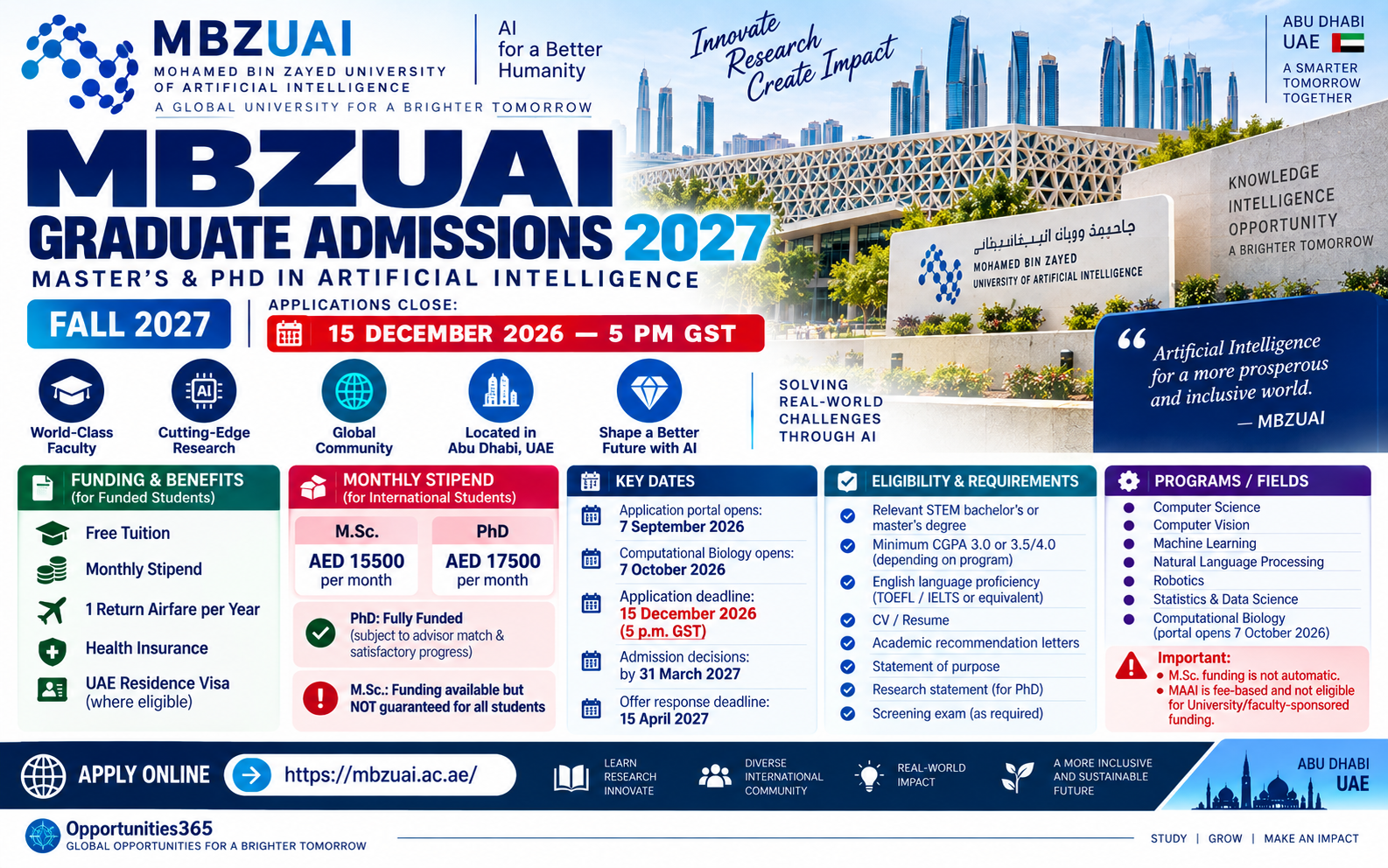
Country: United Arab Emirates
University: Mohamed bin Zayed University of Artificial Intelligence (MBZUAI)
Degree: Master's, PhD
Deadline: 2026-12-15
MBZUAI Graduate Admissions 2027 offers international students an opportunity to pursue advanced education and research in Artificial Intelligence at Mohamed bin Zayed University of Artificial Intelligence in Abu Dhabi, United Arab Emirates. MBZUAI is a specialized university dedicated to artificial intelligence education, research and innovation, with graduate programs designed for students seeking advanced knowledge in areas such as Machine Learning, Computer Vision, Natural Language Processing, Robotics, Computer Science, Statistics and Data Science, and related AI disciplines. The university attracts students from different countries who are interested in developing advanced technical knowledge and conducting research in artificial intelligence. Its graduate admissions process evaluates applicants according to factors including academic excellence, technical preparation, research potential and alignment with the selected program. Because MBZUAI is a specialized AI university, applicants are expected to demonstrate an academic background and preparation that are relevant to their intended area of graduate study. The 2027 Fall semester at MBZUAI is scheduled to begin in mid-August 2027. The graduate admissions cycle opens during September 2026, giving prospective students several months to prepare their academic documents, research materials, English-language evidence and other application components before the applicable final deadline. MBZUAI's graduate admissions are available across both Master's and PhD programs. The university currently offers several specialized master's degrees as well as doctoral programs covering major areas of artificial intelligence. Applicants should carefully distinguish between the research-oriented M.Sc. and Ph.D. programs and the Master in Applied Artificial Intelligence (MAAI), because their academic structures, funding arrangements and admission requirements are not identical. The university's research-focused Master's programs are designed for students who want to develop advanced knowledge and participate in research in artificial intelligence and related technical disciplines. These programs include fields such as Computer Science, Computer Vision, Machine Learning, Natural Language Processing, Robotics, and Statistics and Data Science, along with other graduate offerings listed by the university. MBZUAI also offers a Master of Science in Computational Biology, subject to the relevant regulatory status and admissions availability. At the doctoral level, MBZUAI offers PhD programs in several AI-related research fields. These include Computer Science, Computer Vision, Machine Learning, Natural Language Processing, Robotics, and Statistics and Data Science. The university also lists Computational Biology and Human-Computer Interaction in its doctoral portfolio, with their availability subject to the applicable regulatory status. Doctoral study places greater emphasis on original research, scientific contribution, dissertation work and the development of advanced expertise within a specific research area. Applicants interested in pursuing a PhD at MBZUAI should understand that doctoral admission is strongly research-oriented. A PhD applicant is expected to demonstrate the ability to identify a meaningful research problem and explain how their academic background and experience prepare them to investigate that problem. The application therefore includes a research statement, which is used by the admissions committee to evaluate the applicant's research interests, preparation and potential. MBZUAI's research statement requirements are particularly relevant for applicants who are applying to doctoral programs. The university asks applicants to explain a potential research project, identify the research gap they intend to address, place the proposed work in the context of existing literature and describe how they would investigate the problem. The research statement can include a problem definition, literature review, proposed research or solution, study timeline and references. Applicants are expected to prepare this document independently. The university also places importance on the applicant's broader academic and professional profile. The application may include a curriculum vitae, statement of purpose, research statement and referee recommendations, along with academic records and other required materials. These components allow the admissions committee to understand the applicant's previous education, technical experience, research interests, achievements and reasons for pursuing graduate education at MBZUAI. For applicants whose first language is not English, MBZUAI requires evidence of English proficiency unless the applicant qualifies for an applicable language waiver. Accepted examinations include IELTS Academic, TOEFL iBT, PTE Academic, Cambridge C1 Advanced, Cambridge C2 Proficiency and the Duolingo English Test, subject to the minimum scores and conditions specified by the university. MBZUAI also provides English-language exemptions in certain circumstances. For example, applicants may qualify for a full exemption if they completed a degree entirely taught and assessed in English at a university located in a country where English is both an official language and the dominant language of instruction in higher education. Applicants whose degree was completed elsewhere may be able to request a conditional exemption by providing official university documentation confirming that the entire degree was taught and assessed in English. Another distinctive component of MBZUAI's graduate admissions process is the screening exam. The university states that completing the screening exam is mandatory for applicable applicants. The exam assesses knowledge and skills relevant to the selected field. Depending on the program, applicants can expect areas involving mathematics, programming and machine learning. The mathematics portion can include topics such as calculus, linear algebra, probability and statistics. Programming preparation can involve control flow, data structures, Python and recursion. Machine learning topics can include areas such as classification, convolution, dimensionality reduction, gradient descent, neural networks, optimization, regression and unsupervised learning. This screening component makes preparation especially important for applicants coming from technical backgrounds. Students should review the mathematical foundations of AI and machine learning, programming concepts and core machine-learning theory before taking the examination. MBZUAI itself provides guidance and recommended learning resources for applicants preparing for the screening exam. Following the screening stage, a selected group of applicants may be invited to a technical interview or admission interview with faculty members or members of the admissions committee. The university provides the relevant instructions to applicants who are invited to this stage. The interview can form part of the overall evaluation of an applicant's academic and technical preparation. MBZUAI's graduate admissions are highly competitive, and the university states that space in the incoming cohort is limited. Applicants should therefore ensure that all information submitted in the application is accurate and that their academic, research and technical background is presented clearly. For students considering a Master's degree, it is important to understand that not every MBZUAI Master's program has the same funding arrangement. The university's current funding model states that M.Sc. students are fee-paying by default, although merit-based funding may be available. Funding can also become available through a faculty-sponsored research or teaching assistantship or, in applicable circumstances, an approved government scholarship. The university's current funding model explains that M.Sc. funding is not guaranteed for every admitted student. A student without an applicable funding source is classified as fee-paying. This is an important distinction for international applicants because admission to an M.Sc. program should not automatically be interpreted as an award of a fully funded scholarship. The Master in Applied Artificial Intelligence (MAAI) is different from the research-oriented M.Sc. programs. MBZUAI describes the MAAI as a fee-based program designed to address the application of artificial intelligence in industry, research and government environments. It can be pursued in full-time or part-time formats, and the program is delivered on campus. The MAAI currently has a tuition cost of AED 170,000, based on AED 5,000 per credit for its 34-credit curriculum. MBZUAI states that the MAAI is not eligible for University or faculty-sponsored funding. Applicants interested in this program should therefore plan for the applicable tuition and other costs rather than assuming that the funding model used for PhD or funded M.Sc. students applies to MAAI. The PhD funding structure is different. MBZUAI's current graduate funding model states that PhD students receive university-supported funding during the initial period while they are being matched with a faculty advisor. Funding then transitions to the faculty advisor's funding no later than the start of the second year, subject to the university's conditions and a confirmed advisor match. For funded students, MBZUAI currently lists benefits that can include tuition fee coverage, a monthly stipend, one return airfare each year to the student's home country, health insurance for the approved funding period, and a university-sponsored UAE residence visa and Emirates ID where eligible. The exact funding arrangement remains subject to the student's program, academic standing, funding source and applicable university terms. The university currently lists monthly stipend amounts of AED 15,500 for international M.Sc. students and AED 17,500 for international PhD students under the applicable funded-student structure. However, the M.Sc. amount should not be interpreted as an automatic award to every admitted M.Sc. applicant because the current university funding model explicitly states that M.Sc. funding is not guaranteed for all admitted students. MBZUAI's graduate environment is particularly suited to students who want to develop expertise in artificial intelligence through a combination of coursework, research and technical development. Students can work in specialized AI areas and gain exposure to research problems that involve machine learning, robotics, language technologies, computer vision, data science and other areas. The Machine Learning program is relevant to applicants interested in developing advanced methods for learning from data. Machine learning research can involve areas such as optimization, deep learning, statistical learning and other approaches used to build intelligent systems. The Computer Vision program focuses on AI methods for understanding and processing visual information. Students interested in image understanding, visual recognition and related research areas can explore this academic pathway according to the current program structure and research opportunities. The Natural Language Processing program is relevant to students interested in AI systems that process and understand human language. Research in this area can include language models, computational linguistics and other methods for developing intelligent language-processing systems. The Robotics program combines artificial intelligence with robotic systems and autonomous decision-making. Students can work on research involving intelligent robots, sensing, planning, control and related technologies. The Statistics and Data Science program focuses on statistical and analytical methods for extracting information from data and supporting data-driven decision-making. The program is relevant to applicants interested in predictive modeling, quantitative analysis and statistical research. MBZUAI also offers Computer Science as a graduate field, providing students with opportunities to pursue advanced study and research across computer science areas connected to artificial intelligence and computing. For applicants interested in interdisciplinary research, MBZUAI also has graduate offerings connected to Computational Biology, where AI and computational methods can be applied to biological data and problems. Availability of specific programs can depend on regulatory approval and the university's current admissions cycle, so applicants should verify the status of their intended program before submitting an application. One of the important aspects of applying to MBZUAI is selecting a program that matches the applicant's previous academic preparation. The university generally expects graduate applicants to have a background in a STEM field, such as computer science, electrical engineering, computer engineering, mathematics, physics or another relevant science or engineering discipline, although specific programs can have their own requirements. For research-focused
A research-focused graduate education opportunity at MBZUAI for students seeking advanced training and research experience in artificial intelligence and related computational fields.
Explore scholarships and opportunities by category