
Country: Indonesia
University: Universitas Islam Internasional Indonesia (UIII)
Degree: Bachelor's, Master's, PhD
Deadline: 2027-03-31
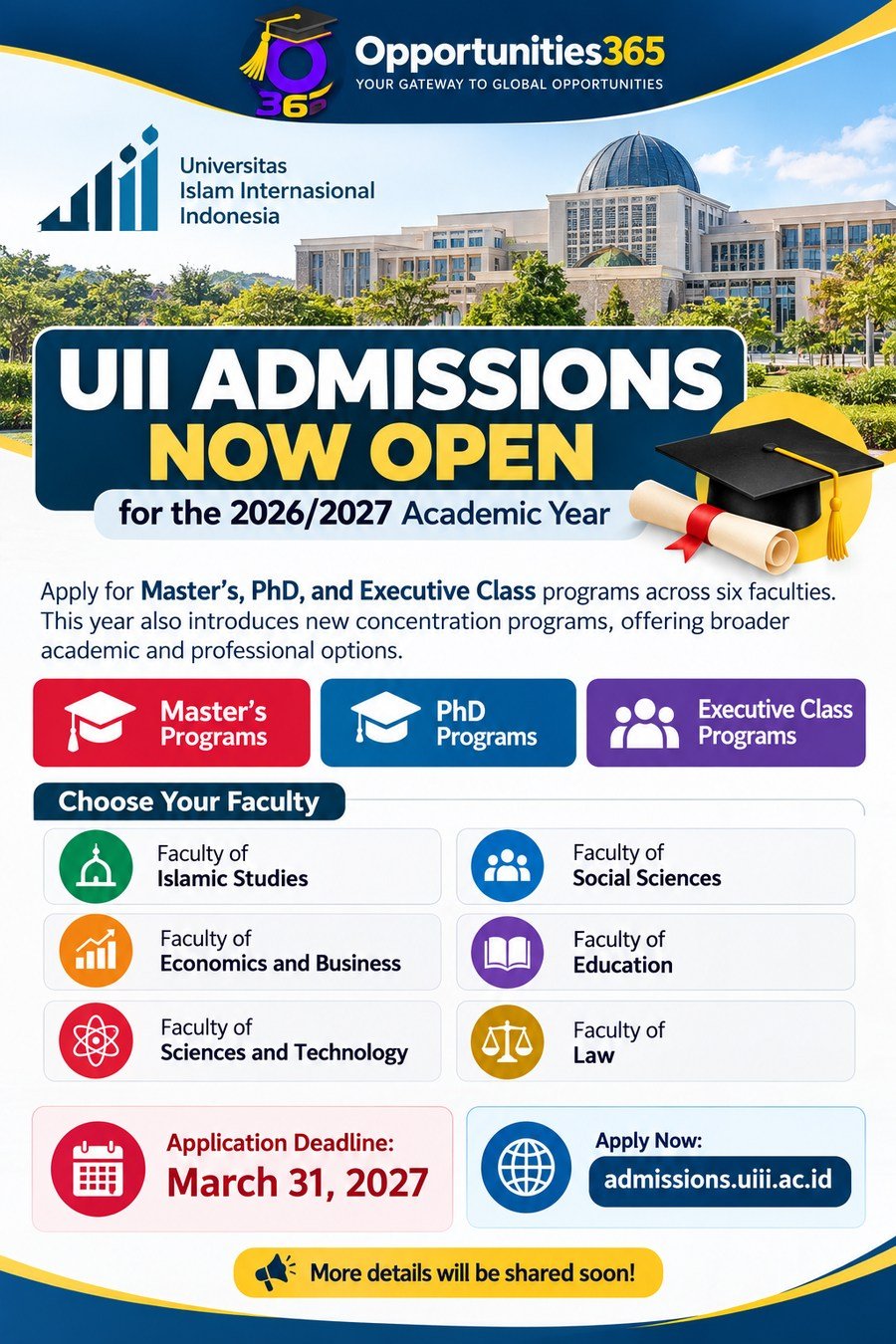
Introduction Universitas Islam Internasional Indonesia (UIII) has opened admissions for the 2026/2027 academic cycle, providing opportunities for prospective students to pursue postgraduate education in Indonesia through Master’s, PhD, and selected Executive Class programs. The university brings together an international academic environment with a focus on Islamic perspectives, social sciences, humanities, economics, education, science and technology, and law. For the current admission cycle, the official UIII Admissions Portal lists an application deadline of 31 March 2027. The admission process is conducted through the university’s official online admissions portal, and applicants are required to submit their applications and supporting documents through the designated system. UIII’s academic structure is organized across six faculties: Faculty of Islamic Studies, Faculty of Social Sciences, Faculty of Economics and Business, Faculty of Education, Faculty of Sciences and Technology, and Faculty of Law. This provides applicants with a broad range of academic disciplines and research areas at postgraduate level. About Universitas Islam Internasional Indonesia Universitas Islam Internasional Indonesia, commonly known as UIII, is an international Islamic university located in Depok, West Java, Indonesia. The university was established with an emphasis on postgraduate education, research, and the study of Islam and society from interdisciplinary and international perspectives. UIII describes its academic environment around the concept of “Global Standards, Islamic Perspective.” Its academic model combines international standards of postgraduate education with research and scholarship related to Islam, Muslim societies, public policy, economics, education, science, technology, and law. The university has developed an international academic community consisting of students and academics from different countries. Its postgraduate programs are designed to encourage advanced theoretical understanding, research skills, academic writing, critical thinking, and engagement with contemporary issues. Admissions for the 2026/2027 Academic Year The current UIII admission cycle provides opportunities for applicants seeking postgraduate study. The official admissions system identifies Master’s and PhD programs as major admission categories, while UIII also offers an Executive Class format in selected programs. The current admission timeline shows that admissions opened on 23 September 2026, followed by administrative selection, desk review, interview selection, faculty reporting, issuance of Letters of Acceptance, and the subsequent scholarship application period. The official deadline for submitting the admission application is 31 March 2027. Applicants should therefore complete their accounts, prepare their academic and supporting documents, and submit the application through the official UIII Admissions Portal before the stated deadline. According to the official timeline, administrative selection takes place from 5 October 2026 to 2 April 2027, desk review selection from 12 October 2026 to 7 April 2027, and interview selection from 4 January to 14 April 2027. Faculties are scheduled to report their results during 15–18 April 2027, followed by the issuance of Letters of Acceptance from 19–22 April 2027. The scholarship application period is scheduled for 22–29 April 2027, with scholarship results announced on 30 April 2027. Six Faculties at UIII UIII provides postgraduate study opportunities through six major faculties. The Faculty of Islamic Studies focuses on Islamic scholarship and Muslim societies through interdisciplinary, multidisciplinary, and transdisciplinary approaches. Programs include areas such as Islamic Studies, Turath Islam, and emerging areas such as Digital Islam. The Faculty of Social Sciences provides academic opportunities related to political science and contemporary social and political issues. Its programs include areas such as comparative politics and international relations. The Faculty of Economics and Business offers postgraduate study in economics, finance, and related areas. UIII currently lists programs including Economics and Sustainable Finance, while its Executive Class includes the Master of Finance in Sustainable Finance. The Faculty of Education provides postgraduate study and research opportunities in education. UIII lists doctoral-level study in Education and master's-level education programs, including areas such as educational psychology and educational leadership. The Faculty of Sciences and Technology provides programs connected with contemporary scientific and technological disciplines. UIII lists programs such as Master of Science in Data Science, providing opportunities for applicants interested in data-driven research and technology. The Faculty of Law offers postgraduate legal education, including programs related to global, transnational, environmental, and sustainability law. Master’s Programs UIII’s Master’s programs are designed to provide advanced theoretical knowledge, research methodology, specialized academic understanding, and preparation for further research or professional careers. The university explains that Master’s students are generally not required to select a formal specialization at the beginning of their studies. Instead, students can develop academic interests through elective courses and research themes, which can later contribute to specialization at the doctoral level. Current Master’s offerings include programs in areas such as Islamic Studies, Digital Islam, Turath Islam, Political Science, Public Policy, Economics, Sustainable Finance, Education, Data Science, and Law. The exact availability of programs and concentrations should be checked on the official admissions portal before applying. One of the newer academic developments at UIII is the M.A. in Islamic Studies Specializing in Digital Islam. The program connects Islamic Studies with digital humanities, computational approaches, programming, data analysis, and emerging technologies. UIII describes this concentration as an interdisciplinary and transdisciplinary response to developments in technology and humanities research. PhD Programs UIII also provides doctoral-level education for applicants who already possess the required postgraduate academic qualification. Doctoral programs are intended for students who want to develop advanced expertise in their selected discipline and conduct original research. UIII describes its doctoral education as requiring strong mastery of theories, methodologies, and specialized areas of research. The university currently lists PhD opportunities in fields including Islamic Studies, Political Science, Economics, and Education. Doctoral applicants should carefully review the requirements of their selected program because doctoral admission normally involves additional research-related materials. For example, the PhD in Islamic Studies requires applicants to demonstrate an appropriate academic background and submit materials including a curriculum vitae, academic references, motivation letter, research proposal, and academic writing samples. Executive Class Program UIII also provides an Executive Class option designed for professionals who want to pursue postgraduate education while continuing their professional careers. One officially listed Executive Class program is the Master of Finance in Sustainable Finance Executive Class, offered by the Faculty of Economics and Business. The program is designed around applied learning, field case studies, sustainability, ESG, financial risk, climate change, impact investing, and regulatory frameworks. The Executive Class format is intended to accommodate working professionals through a more flexible structure. The program requires a minimum of 42 credits and is designed to be completed in approximately two years. The official entry requirements for this Executive Class include a minimum GPA of 3.00/4.00, an accepted English-language qualification, a minimum of three years of relevant professional work experience, a curriculum vitae, reference contacts, and a motivation letter. Academic Qualifications For Master’s admission, applicants generally need an undergraduate degree from an accredited higher education institution. UIII's current admission requirements specify a minimum academic standard of GPA 3.00 on a 4.00 scale for many Master’s programs. For PhD admission, applicants generally need a relevant Master’s degree and a minimum GPA requirement that can be higher depending on the selected program. The current UIII admissions portal lists GPA 3.50/4.00 for the PhD in Islamic Studies. Because requirements can differ between faculties and programs, applicants should not assume that one set of requirements applies to every UIII program. English Language Requirements English is an important component of UIII postgraduate admission because the university operates an international academic environment and uses English for its programs. The official admissions portal lists different minimum scores depending on the degree and program. For general Master’s programs, accepted minimums include TOEFL iBT 80, TOEFL ITP 525, PTE Academic 58, or IELTS 6.0. For Law programs, the IELTS requirement is 6.5. For Dual Degree Master’s programs, the listed IELTS requirement is 6.5, while PhD applicants generally require TOEFL iBT 94, TOEFL ITP 550, PTE Academic 65, or IELTS 6.5. Applicants should ensure that their language certificate meets the validity requirements. UIII states that language certificates should generally be no more than two years old prior to the start of study. Application Documents The required documents depend on the selected program. However, UIII commonly requires applicants to provide academic records and supporting documents through the admissions system. Potential application materials include an academic certificate and transcript, English-language proficiency certificate, curriculum vitae, academic or professional references, motivation letter, and other program-specific documents. PhD applicants may additionally be required to provide a research proposal and academic writing samples. Some programs may also have additional language or academic requirements. Applicants should consult the requirements for their chosen program directly rather than submitting a generic set of documents. Scholarships and Financial Support Admission to UIII and scholarship consideration are related but separate processes. UIII provides several scholarship schemes for eligible students, including the UIII Scholarship and other scholarship partnerships. The official admissions timeline shows that the scholarship application period for this admission cycle is scheduled after the admission process, from 22 to 29 April 2027, with scholarship results scheduled for 30 April 2027. Applicants should not assume that admission automatically means that the student will receive a scholarship. Scholarship eligibility, available programs, age requirements, funding conditions, and selection criteria depend on the specific scholarship scheme. UIII also provides a self-funded study route. Current official information lists tuition for many Master’s programs at IDR 25,000,000 per semester, PhD programs at IDR 30,000,000 per semester, and the M.Fin Sustainable Finance Executive Class at IDR 50,000,000 per semester. Applicants should check the current program page for the latest applicable tuition information. Application Fee The official admissions portal currently lists an application registration fee of IDR 750,000 for Indonesian applicants and USD 50 for international applicants. The application fee should be considered separately from tuition and any scholarship funding. Applicants should follow the payment instructions provided inside the official application system. How to Apply Applicants should begin by visiting the official UIII Admissions Portal and creating an account during the application period. After selecting the appropriate degree and faculty, applicants should review the specific requirements of their intended program. The applicant should then prepare the required academic records, English-language certificate, curriculum vitae, references, motivation letter, and any additional research documents required by the selected program. Applicants must upload their documents through the official online application system. UIII states that the admissions portal is the designated application channel and that applications should not be submitted through alternative channels such as email or offline submission. After submission, applications go through the university's selection process. This may include administrative verification, document or desk review, and an interview depending on the program and admission process. Applicants who successfully complete the admission process may receive a Letter of Acceptance (LoA) according to the published timeline. Eligible applicants can then proceed to the scholarship application stage where applicable. Important Information for International Applicants International applicants should carefully review the requirements for foreign qualifications, language certificates, passport documentation, immigration procedures, and financial requirements where applicable. UIII's official portal provides specific instructions for foreign applicants, including requirements related to academic qualification and GPA conversion in cases where previous degrees use a grading scale other than 4.00. Applicants should also ensure that all required documents are prepared in the language specified by their selected program. Some programs have particular language requirements, especially specialized programs such as Turath Islam. Why Consider UIII? UIII provides an academic environment focused on postgraduate education, international scholarship, research, and interdisciplinary study. Its six faculties create opportunities for students with different academic backgrounds, ranging from Islamic Studies and social sciences to economics, education, science and technology, and law. The university's academic model also provides opportunities to connect traditional Islamic scholarship with contemporary academic disciplines. Programs such as Digital Islam demonstrate this approach by bringing Islamic Studies into conversation with digital humanities, programming, data analysis, and technological developments. For professionals, the Executive Class structure offers an alternative postgraduate pathway focused on applied learning and professional relevance. Final Overview The UIII Admissions 2027 opportunity provides prospective students with access to postgraduate education at Universitas Islam Internasional Indonesia in Depok, Indonesia. The current admission cycle covers Master’s, PhD, and selected Executive Class programs across six faculties. The official application deadline is 31 March 2027. Applicants should carefully select their faculty and program, check the program-specific academic and English requirements, prepare all required documents, and submit their application through the official UIII Admissions Portal. UIII also provides several scholarship schemes, but scholarship consideration follows its own eligibility and application process. Applicants seeking financial support should therefore review the scholarship information separately after understanding the admission requirements. Because individual programs can have different GPA, language, professional experience, research, and document requirements, applicants should always verify the exact requirements of their selected program before submitting an application.
Explore scholarships and opportunities by category